Review · LOS ANGELES
Oscar History and Film Set Studio Tour at the Biltmore Hotel
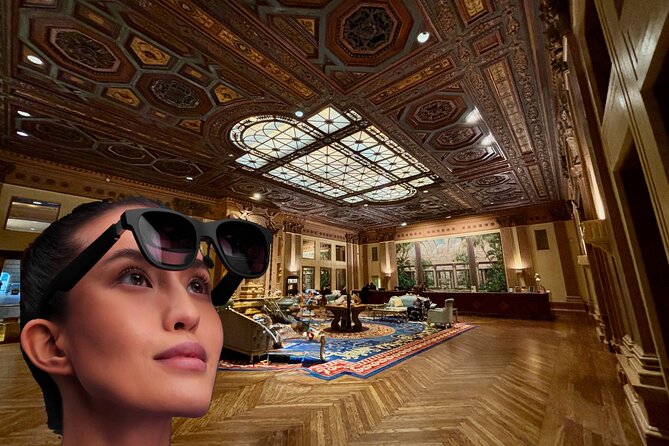
The clever idea here is simple: you stand in the actual Biltmore spaces while smart glasses show you what happened there. Oscar ceremonies, JFK’s 1960 nomination, Prohibition-era stories, and scenes from Ghostbusters appear over the rooms in front of you. It turns a grand old hotel into a working history lesson and film set.
I especially like the link between real rooms and screen history. Seeing a Ghostbusters scene while standing in the same space gives the movie connection more weight than a list of filming locations. I also like the small group size, capped at 10, which should make it easier to follow Eloi or Mark and ask questions.
The main drawback is the short one-hour format. The Biltmore has more stories than can fit into a quick visit, and the smart glasses may not appeal to anyone who prefers a quiet architecture tour without technology. At $25, the price is fair, but you are paying for a focused, guided experience rather than a long hotel visit.
Key points at a glance
- Smart glasses put history into the rooms: Watch old photographs, film clips, and event footage while standing at the real locations.
- The first Academy Awards connect the hotel to Hollywood: The Historic Corridor helps explain why the Biltmore matters beyond its decorative interiors.
- Film fans get exact locations: The tour connects the hotel with Ghostbusters, Chinatown, Fight Club, Beverly Hills Cop, Oppenheimer, and music videos.
- The Crystal Ballroom carries political as well as movie history: You can see footage linked to JFK’s 1960 nomination in the same room.
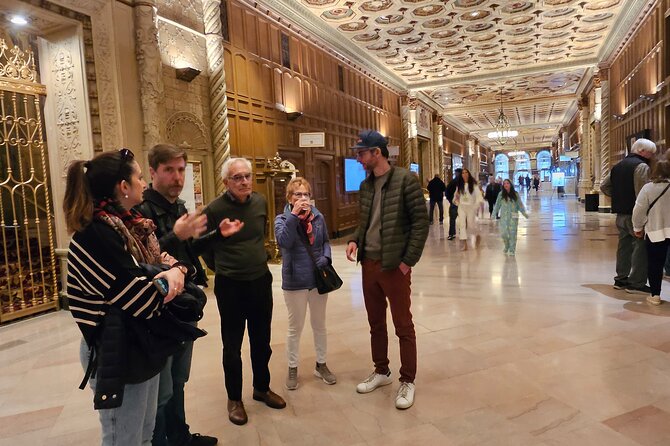
- A small group keeps the hour personal: The maximum is 10 people, with guides Eloi or Mark leading the experience.
- Downtown Los Angeles is part of the story: The Biltmore sits near public transportation in the heart of DTLA.
Why the Biltmore makes a good film tour
Many movie location tours leave you outside a building, pointing at a doorway or street corner. This one takes you inside the location. The Millennium Biltmore Hotel gives the tour a useful advantage because its public rooms contain both movie history and the polished look Hollywood likes to borrow.
The hotel opened more than a century ago, and its interiors reflect several periods of Los Angeles life. You move through Italian Renaissance decoration, Moorish details, grand ballrooms, and corridors that have served both real events and fictional scenes. The setting does much of the work before the guide adds the film footage.
The smart glasses are the unusual part. Instead of looking at a photograph on a phone and then trying to imagine the old room, you can see images and clips while standing in the current space. That creates a direct comparison between then and now.
This is not a virtual reality ride. You remain in the hotel and look at the actual surroundings, with additional visual material sent to the glasses during the walk. A phone is also part of the setup, and the guide helps you through the experience.
More Film Studio Tours in Los Angeles
- Warner Bros. Studio Tour Hollywood
★ 4.5 · 5,246 reviews - Universal Studios Hollywood General Admission Ticket, California
★ 4.0 · 1,489 reviews - Skip the Line: Express Ticket at Universal Studios Hollywood
★ 4.5 · 1,144 reviews
Starting at the Music Room
The tour begins at the Millennium Biltmore Historic Hotel, at 507 South Olive Street. The first interior highlight is the Music Room, where a detailed ceiling filled with cherubs gives you an immediate sense of the hotel’s old-school style.
This is a good place to begin because the room works on two levels. You can study the decoration in front of you, then use the glasses to connect that physical space with earlier images and stories. The Italian Renaissance influence is not just a label here. It appears in the room’s formal design and helps explain the visual language of the hotel.
I would take a moment to look up before focusing on the glasses. The technology is the hook, but the ceiling and surrounding decoration are the reason the hotel remains worth seeing in person. If you spend the whole hour staring only through the device, you could miss the architecture directly in front of you.
Reading the Galleria and Historic Corridor
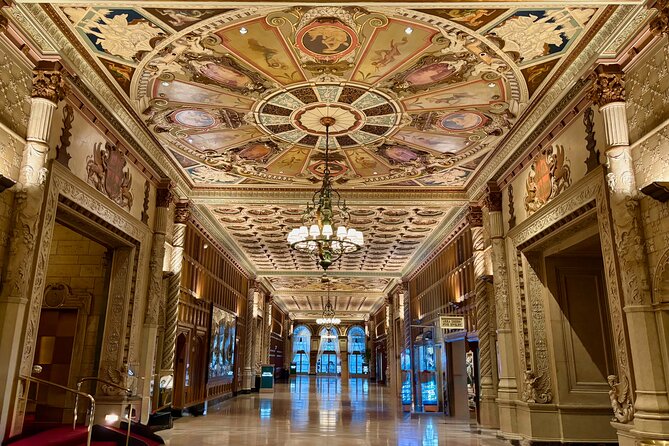
From the Music Room, the route moves through the Galleria, with ornate corridors painted by Giovanni Smeraldi. These spaces help show how the Biltmore was designed as a place for ceremony, movement, and display. You are not simply walking between stops. The corridors are part of the visual experience.
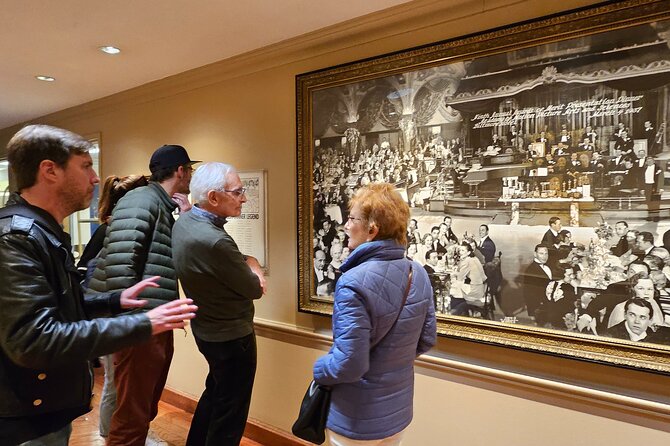
The Historic Corridor has a special place in Hollywood history because the first Academy Awards were held here. That fact gives the tour its clearest Oscar connection. The awards were not always associated with the large modern venues you picture today. Here, the story begins in a hotel corridor in Downtown Los Angeles.
This is where the smart glasses can add real value. A spoken date or a plaque can tell you what happened, but footage and historical photographs let you compare the event with the room itself. You get a stronger sense of scale and setting, even during a short visit.
The corridor also makes a useful point about Los Angeles. Film history is not limited to studio lots and movie palaces. It is built into hotels, restaurants, streets, and public rooms across the city. The Biltmore gives you one compact place where those threads come together.
The Olive Street entrance and Chinatown
The VIP Olive Street Entrance is connected with Chinatown, one of the films linked to the hotel. Seeing the entrance in person gives film fans a concrete location to look for, rather than a general claim that a movie used the building.
The appeal depends on how much you enjoy matching movies to places. If you have seen Chinatown, the clip or image shown through the glasses may sharpen your memory of the scene. If you have not, the guide’s broader explanation of the hotel’s role in Los Angeles film culture still gives the stop a purpose.
The entrance also helps break up the indoor route. You get another angle on the building and a reminder that filming can happen at practical access points, not only in a famous ballroom. This is a small stop, but it adds variety to the walk.
More Film Studio Tours in the USA
- The VIP Experience at Universal Studios Hollywood in California
★ 4.5 · 551 reviews - Warner Bros. Studio Tour & Celebrity Homes Tour Package
★ 3.5 · 225 reviews - Universal Studios Hollywood: VIP Tour with Ticket
★ 4.6 · 170 reviews - Los Angeles: Warner Bros Studio Hollywood & Bus Tour Package
★ 3.6 · 150 reviews
The Crystal Ballroom and JFK’s nomination
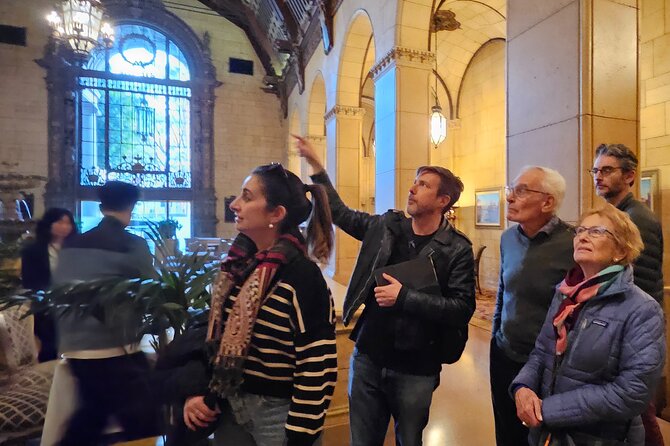
The Crystal Ballroom is likely the grandest stop on the route. It has hosted Hollywood galas and remains one of the hotel’s most striking rooms. Its scale and decoration make it easy to understand why filmmakers return to the Biltmore when they need a classic Los Angeles interior.
The room also carries political history. You can watch footage connected with the 1960 Democratic National Convention, including JFK’s nomination for president, while standing in the ballroom. That detail widens the tour beyond movie trivia. The Biltmore was not only a backdrop for fictional stories. It was also a place where major public events took place.
I like this part of the experience because it gives the building more depth. A film clip may show how directors use a room, but political footage shows how the room functioned in real life. The contrast is useful, especially if you are interested in American history as well as Hollywood.
The ballroom may also be the point where the one-hour limit feels most noticeable. There is enough material here for a longer talk, yet the tour has several more rooms to cover. Expect a brisk introduction rather than a full study of every event associated with the space.
The Gold Room and Prohibition stories
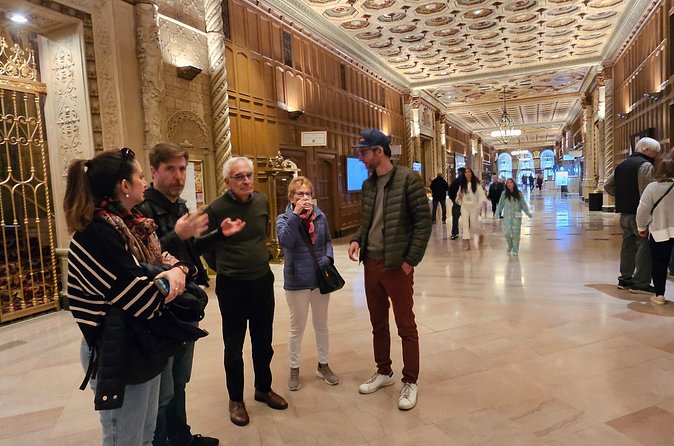
The Gold Room adds a different mood. Its connection with a Prohibition-era speakeasy brings in the hidden, less formal side of the Biltmore. After the public ceremonies of the corridor and ballroom, this stop suggests secret meetings, restricted drinks, and the hotel’s role in an earlier Los Angeles.
The smart glasses are well suited to stories from this period. Old images and footage can make a room feel connected to a particular time, especially when the guide explains what changed and what survived. The experience is at its best when the visual material supports the room instead of distracting from it.
Do not expect a full investigation of Prohibition in Los Angeles. The tour has only an hour, and the Gold Room is one chapter in a much larger story. But it gives the visit a welcome change of pace and shows that the hotel’s past was not all ceremonies and polished galas.
Finishing in the Rendezvous Court
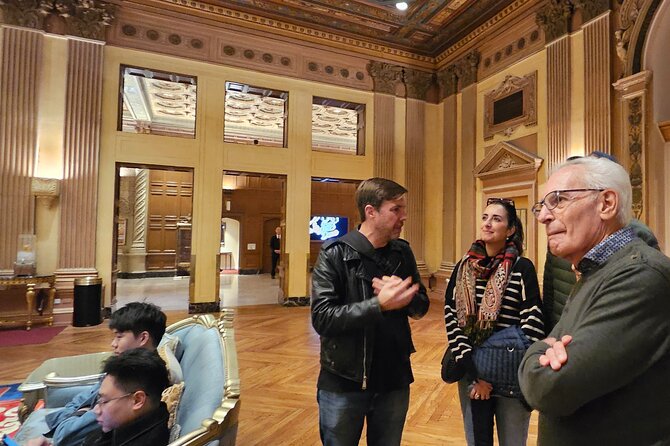
The final stop is the Rendezvous Court, a Moorish-inspired room that provides a strong closing image. Its style differs from the Italian Renaissance influence seen earlier, so the route ends with another change in decoration and atmosphere.
Ending here makes practical sense. You finish inside one of the hotel’s most distinctive spaces and then return to the original meeting point. You do not need to arrange a second pickup location or find your way across Downtown Los Angeles at the end.
The route is compact, but it does not feel limited to one subject. By this point, you have seen architectural details, Oscar history, political footage, Prohibition stories, movie locations, and music-video connections. The Biltmore becomes less a single film set than a record of how Los Angeles has presented itself over time.
What the smart glasses add
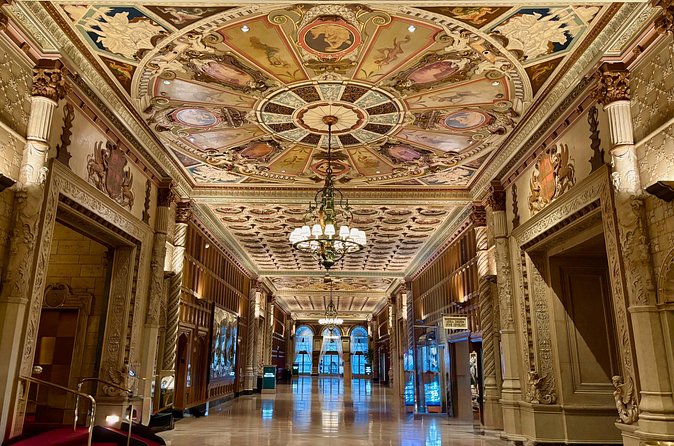
The augmented reality equipment is the reason to book this tour instead of simply walking through the hotel on your own. Clips connected with Ghostbusters, Beverly Hills Cop, Fight Club, Chinatown, and Oppenheimer can appear in the locations where filming took place. Music videos by Taylor Swift and Jisoo are also part of the film and pop-culture material.
That range gives the tour appeal beyond classic Hollywood. You might arrive for the Oscars and find yourself more interested in a modern music video, or come for current pop culture and leave with a better sense of the hotel’s early decades.
The system also presents historical photographs and footage from the silent-film era and the 1920s. This makes the experience useful for people who do not know much about the Biltmore. You are not required to arrive with a long list of movie titles.
There is a tradeoff. Smart glasses are not invisible. You have to wear them, look through them, and pay attention to the guide while also noticing the room. Some people will find this exciting. Others may prefer to keep their eyes on the ceiling, walls, and furniture without an added screen.
The guide matters a lot here. Eloi created the concept, and Eloi or Mark may lead the tour. Both are described as engaging presenters, and the guide’s role is to send the clips and images at the right points and explain what you are seeing. Without that timing, the glasses would be little more than a gadget.
Is $25 a fair price?
At $25 per person, this is a reasonably priced Downtown Los Angeles activity, especially if you care about film locations or unusual local history. You receive a one-hour guided visit, access to the hotel’s notable public rooms, and the added visual material from the glasses.
The value is strongest if you would otherwise pay for a film tour or actively seek out filming locations. The Biltmore connection is concentrated, so you see several types of screen history without spending half a day crossing Los Angeles.
The value is weaker if you mainly want a slow architecture visit. One hour leaves little time for lingering, sketching, or carefully studying every decorative detail. You are buying interpretation and technology as much as access to the building.
Group discounts are available, which may help if you are booking for several people. The maximum group size is 10, a useful limit for a tour where everyone needs to see and hear the guide. It should also make the smart-glasses demonstrations easier to manage than on a large coach-style outing.
Timing, transport, and who should book
The meeting point is at the Millennium Biltmore Historic Hotel in Downtown Los Angeles. The hotel is near public transportation, so you can combine the tour with other DTLA sights without needing a car. The activity ends back at the same meeting point.
The tour lasts about one hour. I would choose it when you have a tight schedule, or as one part of a day exploring Downtown Los Angeles. It is not designed to fill an afternoon.
You should consider booking this if:
- You enjoy seeing real movie locations.
- You want Oscar history explained in its original setting.
- You like technology that adds photos and video to a place.
- You are curious about Downtown Los Angeles beyond the usual attractions.
- You want a short indoor activity with a small group.
- You have children or older relatives who respond well to visual storytelling.
You might skip it if you dislike wearing glasses, want a long architectural lecture, or have no interest in film, television, music videos, or Los Angeles history. The tour’s strength is its mix of subjects, so a visitor seeking only one narrow topic may find the pace too quick.
Confirmation arrives when you book. Most people can take part, and the activity is offered in English. You can cancel for a full refund up to 24 hours before the start time, but cancellations or changes made inside that window are not accepted.
Should you book the Biltmore film tour?
I would book this tour if the idea of watching a movie scene in the exact room where it was filmed sounds better than simply hearing a location listed. The combination of Oscar history, the Crystal Ballroom, Prohibition stories, and smart-glasses footage gives the Biltmore a clear purpose beyond its handsome interiors.
The best reason to go is the direct link between what you see and what you watch. You are not asked to imagine the past from scratch. The images arrive while you are standing in the room, and the guide helps connect the pieces.
Just keep your expectations in line with the format. This is a brisk, one-hour experience, not a complete study of the hotel or Los Angeles film history. For $25, it is a strong pick for film fans, first-time visitors to DTLA, and locals who want to see a familiar landmark from a new angle.
FAQ
Where does the Biltmore film tour begin?
The tour begins at the Millennium Biltmore Historic Hotel, 507 S Olive St, Los Angeles, California 90013.
Where does the tour end?
The activity ends back at the meeting point at the Millennium Biltmore Hotel.
How long does the tour last?
The walking tour lasts approximately one hour.
How much does the tour cost?
The listed price is $25 per person. Group discounts are available.
Is the tour offered in English?
Yes. The tour is offered in English.
How many people can join the tour?
The activity has a maximum of 10 participants.
Can I cancel for a refund?
Yes. You can cancel at least 24 hours before the start time for a full refund. Cancellations or changes made less than 24 hours before the start time are not accepted.
More History Behind the Scenes in Los Angeles
- Historic Hollywood Boulevard and Movie Palaces Walking Tour
★ 5.0 · 9 reviews - Hollywood History Tour
★ 5.0 · 8 reviews - Historic Hollywood Boulevard and Movie Palaces Walking Tour
★ 4.8 · 4 reviews - Los Angeles: Hollywood Hills Spiritual and Cultural Tour
★ 5.0 · 2 reviews
Newly added screen tours around Los Angeles
- Universal Studios Hollywood: Halloween Horror Nights★ 4.2 · 98 reviews
- Limo Tour: Hollywood, Beverly Hills, Santa Monica, Venice, Malibu★ 5.0 · 4 reviews
- Greater Los Angeles and Hollywood Private Tour.★ 4.5 · 4 reviews
- Private Tour – Day Hollywood Tour of Los Angeles – 6 Hours.★ 5.0 · 8 reviews
- Private 4-Hour Limo Tour of Los Angeles and Beaches★ 5.0 · 6 reviews
- Hollywood and Beverly Hills Bus Tour★ 5.0 · 2 reviews
- Universal Studios Hollywood & Celebrity Homes Tour Package★ 3.5 · 46 reviews
- LA Walk of Fame 100 Years of Hollywood Tour By Junket★ 5.0 · 3 reviews
Film Studio Tours in Los Angeles: how the tours compare.
Universal Studios Hollywood General Admission Ticket, California
Read our review →
Skip the Line: Express Ticket at Universal Studios Hollywood
Read our review →
The VIP Experience at Universal Studios Hollywood in California
Read our review →
Warner Bros. Studio Tour & Celebrity Homes Tour Package
Read our review →
Universal Studios Hollywood: VIP Tour with Ticket
Read our review →
Los Angeles: Warner Bros Studio Hollywood & Bus Tour Package
Read our review →